You saved $2,000 upfront. You'll pay $20,000 over the next three years.
That's the math nobody shows you when you click "Buy Now" on a $299 website package or hire the lowest bidder on a freelance marketplace. The price tag looks like a victory. Six months later, it looks like a trap.
I've watched countless business owners celebrate their "smart savings" on a website—only to quietly hemorrhage money, leads, and credibility in the months that follow. The cheap website wasn't cheap. It was deferred expensive.
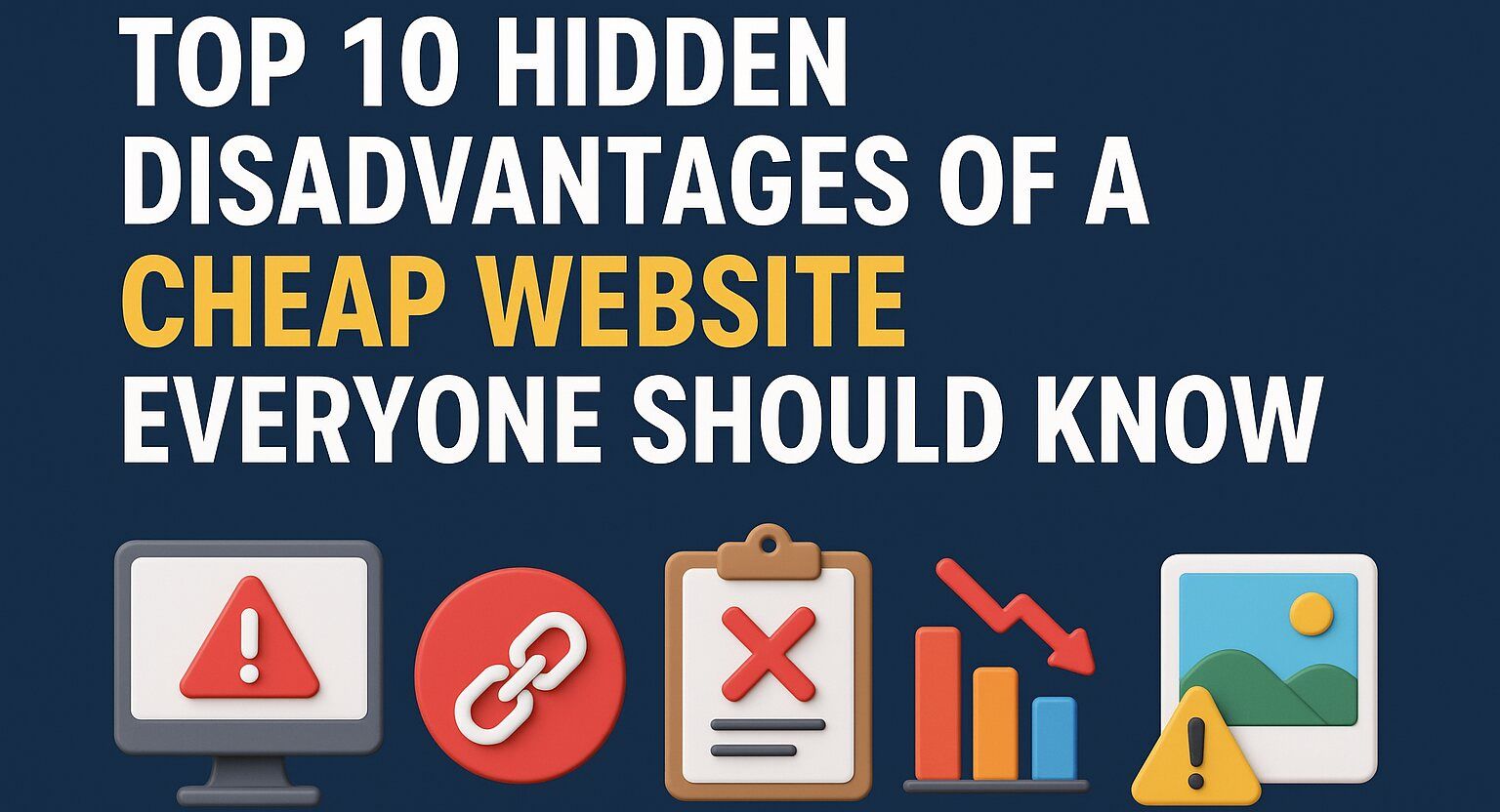
Here are the 10 hidden costs that come bundled with every bargain-basement website. And no, they're not listed in the fine print.
1. You're Invisible on Google (And You Don't Even Know It)
Cheap websites are built to look like websites. They're rarely built to rank like them.
Proper SEO isn't just sprinkling keywords into paragraphs. It's clean semantic HTML, optimized site architecture, fast crawlability, structured data, proper heading hierarchies, and meta strategies. Most budget builders skip all of it—or worse, lock you out of editing it entirely.
The real cost: You spend months (or thousands on ads) driving traffic, while your competitor's properly built site quietly collects the organic leads you should've gotten. You don't lose $500. You lose $500/month, every month, for years.
2. Slow Load Speeds Are Silently Killing Your Sales
A cheap website is often a bloated website. Uncompressed images. Render-blocking scripts. Cheap shared hosting. Spaghetti code held together with duct tape and prayers.
Google's own research shows that 53% of mobile users abandon a page that takes longer than 3 seconds to load. Every additional second of load time can reduce conversions by up to 7%.
The real cost: You're not losing visitors to your competitor. You're losing them to the back button. And you'll never see it in your analytics because they never became a data point. They just… left.
3. Security Vulnerabilities That Could End Your Business Overnight
That $150 website? It's probably running on an outdated CMS, a pirated theme, or a plugin ecosystem no one is maintaining. There's no SSL configuration done properly. No firewall. No regular patching. No malware scanning.
One hack is all it takes. Customer data breached. Google blacklists your domain. Your payment processor shuts you down. Your reputation takes a hit you can't buy back.
The real cost: The average cost of a small-business data breach exceeds $200,000 when you factor in legal fees, notifications, downtime, and lost trust. Your "cheap" website just became the most expensive line item in your history.
4. The "Template Look" That Whispers Amateur
Here's an uncomfortable truth: visitors judge your credibility in about 0.05 seconds. Before they read a single word, they've already decided if you look trustworthy.
Cheap websites use the same templates thousands of other businesses use. Generic stock photos. Default fonts. Cookie-cutter layouts. Your potential client lands on your page, feels a vague sense of "I've seen this before," and mentally files you under "not serious."
The real cost: You don't lose the sale on your site. You lose it before the conversation starts. The lead goes to the competitor whose site felt established, intentional, and premium. Brand perception isn't a luxury. It's revenue.
5. Zero Mobile Experience (In a Mobile-First World)
Over 60% of global web traffic is mobile. Google indexes mobile-first. Your customers are on their phones in line at the coffee shop, in bed at 11 PM, in the passenger seat of an Uber.
Cheap websites often treat mobile as an afterthought—a squished-down desktop view with tiny buttons, broken menus, and text you need a magnifying glass to read.
The real cost: More than half your potential audience is having a frustrating, confusing experience with your brand. They won't complain. They'll just buy from someone whose site actually works on their phone.
6. No Support, No Maintenance, No One to Call
The freelancer who built your site for $200? Ghosted three weeks after launch. The agency that offered a "$99 website deal"? Their "support" is a chatbot and a 72-hour email response time.
Then your contact form breaks. A plugin update crashes your checkout page. Your hosting expires and your site goes dark on a Friday night before a product launch.
The real cost: You spend hours on forums, YouTube tutorials, and panicked emails. Or you hire an emergency developer at 3x the normal rate to fix a problem that proper maintenance would've prevented. You wanted to save money. Instead, you're paying a premium for panic.
7. The Lock-In Trap and Sneaky Recurring Fees
That "$49/month website builder" seems harmless. Until you try to leave.
Many cheap platforms don't let you export your site. Your content, your design, your domain configuration—it's all trapped inside their ecosystem. Want to move? Start over. Want to add an e-commerce feature? That's a $30/month upgrade. Need more storage? Another tier. Want to remove their branding from your site? Premium plan only.
The real cost: What started at $49/month is now $149/month, and you still can't leave without losing everything. You're not a customer. You're a hostage with a subscription.
8. No Scalability Means Rebuilding From Scratch
Your business grows. You want to add a blog, a membership area, an online store, a booking system, multi-language support. You call your cheap developer.
"That's not possible with this setup. You'll need a whole new site."
The foundation was never built to grow. The code is a tangled mess. The platform doesn't support integrations. The architecture is a dead end.
The real cost: You pay for a website twice. The cheap one you outgrew in 14 months, and the proper one you now need. Plus the migration headaches, the SEO reset, the retraining, the downtime. The "savings" evaporated the moment you hit a growth milestone.
9. Poor UX and Conversion Design Leave Money on the Table
A website isn't a brochure. It's a sales system. Every headline, button color, page flow, trust signal, and call-to-action is a conversion decision.
Cheap websites are designed to exist, not to convert. There's no user journey mapping. No A/B testing. No heatmaps. No strategic placement of CTAs. No understanding of buyer psychology. The site "looks fine," but it doesn't guide anyone toward a purchase, a signup, or a phone call.
The real cost: Let's say your site gets 1,000 visitors a month. A well-designed site converts 3–5%. A poorly designed one converts 0.5%. That's the difference between 50 leads and 5 leads. Multiply that by your average customer value, and the "cheap" website is costing you five figures in lost revenue every quarter.
10. The Opportunity Cost You'll Never See on an Invoice
This is the biggest one, and it's the one that never shows up as a line item.
Every month your website underperforms—ranks poorly, loads slowly, looks generic, fails to convert—is a month your competitors are pulling further ahead. It's a month of brand equity you didn't build. A month of trust you didn't earn. A month of compounding growth you didn't get.
You can't put a number on the launch you delayed, the partnership that fell through because your site looked unprofessional, or the investor who clicked your link and quietly closed the tab.
The real cost: Time. Momentum. Market position. The gap between where you are and where you could be widens every single day. And you can't buy that time back.
The Bottom Line
A cheap website isn't a product. It's a down payment on a more expensive problem.
The businesses that win online don't treat their website as an expense to minimize. They treat it as infrastructure to invest in—like a storefront, a sales team, and a brand ambassador rolled into one.
Does that mean you need to spend $50,000? Absolutely not. But it means you should spend wisely, with a clear understanding of what you're actually buying: strategy, security, performance, scalability, and design that converts.
The question was never "How cheap can I get a website?"
The question is: "How much is a bad website costing me every single day I keep it live?"
Do that math. Then decide.
🛠️ Ready for a Website That Actually Works For You?
If you read this and felt a little too seen—maybe your current site is slow, generic, stuck on a template, or quietly leaking leads—I can help.
I'm Nafiz, a web developer who builds sites that are engineered to perform, not just exist. No cookie-cutter templates. No ghosting after launch.
Here's what you get when we work together:
✅ Custom-built, conversion-focused design tailored to your brand and your audience—not a recycled theme.
✅ SEO baked in from day one, so Google actually finds you and sends you organic traffic.
✅ Blazing-fast load times with optimized code, compressed assets, and quality hosting setup.
✅ Mobile-first, responsive experience so every visitor gets a seamless journey on any device.
✅ Security best practices implemented from the start—SSL, firewalls, updates, and peace of mind.
✅ Scalable architecture that grows with your business, not against it.
✅ Ongoing support and maintenance, so you're never stuck Googling "why is my contact form broken" at midnight.
Whether you need a brand-new site built from the ground up, a full redesign of the one you've outgrown, or a rescue mission for a website that's actively costing you money—I've got you.
👉 Let's talk about your project.
My portfolio: https://nafizdevportfolio.vercel.app/
Your website should be your hardest-working employee. Let's build one that actually clocks in.